Summer Reflection from Ashley Estelle

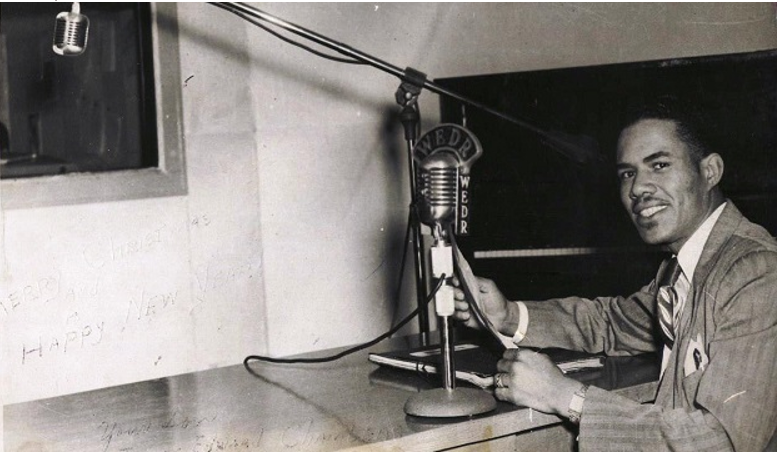
This summer, I had the privilege of interning at the Birmingham Black Radio Museum (BBRM). Founded by Bob Friedman, the BBRM serves to chronicle the city’s African American radio legacy from the 1930s through the 1980s, when AM radio was the most accessible frequency to listeners. Collecting oral histories and important ephemera, the BBRM archive highlights the evolving culture of the medium and its impact on the community as the broadcast format expanded over time. 

 Working within this important archive, I gained hands-on experience in historical research, archival processing, and data management, all while learning about the dynamic role Black radio played in shaping Birmingham’s social and political life.

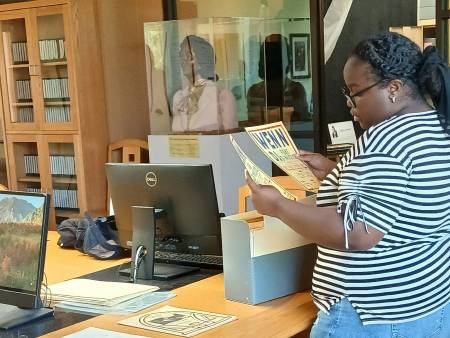
My primary focus this summer was creating a finding aid for a new archival collection centered on Rev. Dr. Erskine Faush – a pastor, radio broadcaster, and gospel concert promoter who helped bring national gospel talent to Birmingham stages and airwaves. The materials for the collection were generously donated by his wife, Audrey Faush. When I was first introduced to the various documents and ephemera, I was amazed by the condition and amount of items—receipts, handwritten notes, programs, and even tickets from events he had organized were all pretty well-preserved. While I was eager to begin processing the materials, I also recognized how new this work was for me.  For the first two weeks of my internship, I focused on carefully documenting everything I could and taking notes of what the collection included without moving much around.

Through that process, I realized the complexities of archival work. Since the materials weren’t pre-organized, I had to think critically: What was the best way to arrange them? Which items held enough significance to be formally included in the collection, and which did not? These questions shaped the foundation of my work moving forward.

I leaned heavily on the knowledge and experience of Mr. Friedman, who had interviewed Rev. Faush in 1997. As I sorted through materials, I made sure to listen to his stories about influential figures in Birmingham radio and his recollections of Rev. Faush’s involvement with stations like WBCO and WENN radio. I also consulted existing collections on the BBRM website, which helped me understand how things had already been organized – as well as looking at anything that was already Rev. Faush-related – in order to gain more knowledge on the specific collection I was working on. As I became more familiar with the collection, I began to understand that organizing archival materials is ultimately a form of storytelling. The most rewarding part of this project was realizing how connected Rev. Faush was to the Black community of Birmingham. Talking to my mom and aunts about their memories of listening to figures like Rev. Faush and Paul “Tall Paul” White helped me connect the physical documents I handled every day to real people and lived experiences.

As my understanding of Rev. Faush deepened, so did my confidence in how to best present his collection. He wasn’t just a devout Christian and minister; he was also a gifted singer, a businessman, and had a great voice for radio. To reflect this complexity, I chose to arrange the materials in two main sections: first, a chronological organization of items directly related to Rev. Faush, followed by a thematic grouping of materials that were more broadly connected to his work and personal life.

Although the documents arrived out of order, I noticed that older folders often listed concerts he planned roughly every two months. Using those dates as a framework, I preserved the original folder groupings when possible, pairing them with corresponding letters and performance contracts. It felt like assembling a puzzle, each piece revealing more of the story and how Rev. Faush had planned things for the community.

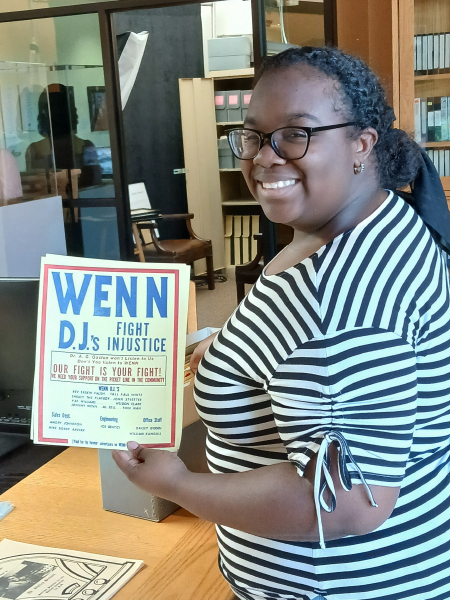
Cataloging materials ranging from handwritten letters to concert contracts and church programs gave me an intimate view of Rev. Faush’s dual legacy as both a media figure and community minister. Notable highlights of his collection included a 1965 telegram from Dr. Martin Luther King Jr., correspondence with gospel legends like Dorothy Norwood and James Cleveland, and various documents related to the 1976 WENN radio walkout. What was most interesting about the documents relating to the walkout was how Rev. Faush had collected various items from the event, like flyers, agreements, and news coverage. With the items found within his collection alone, another story could be told, particularly about the community at WENN radio. 

Through this work, I not only developed practical archival skills in arrangement and description but also gained a deeper appreciation for the significance of Black radio as a cultural and organizing force in Birmingham. Rev. Faush’s broadcasts weren’t simply about gospel music; they were also lifelines of faith and empowerment for a community navigating the challenges of the civil rights era.

What inspires me most about BBRM is how it has evolved from personal oral histories and scrapbooks into a professional, community-rooted archive. As someone heavily invested in historical preservation, this internship made me realize that archives aren’t just about preserving—they’re acts of cultural care and a place of truth. Each folder I organized wasn’t just a set of documents, but part of a much larger story about Black self-representation, religious life, and a particular history in the South.

I’m deeply grateful to Director Bob Friedman and the BBRM team for welcoming me into this important work. This experience has not only expanded my archival skill set but also deepened my appreciation for Black media history. I leave this summer proud to have contributed to the legacy of preserving Birmingham’s Black radio voices.
Birmingham Black Radio Museum welcomes Ashley Estelle for summer internship

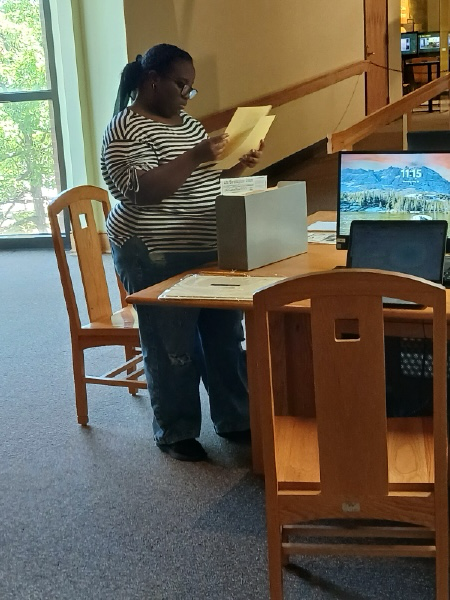
A rising Senior from the University of Notre Dame, Ashley Estelle has dove in head first, working as a Summer intern, developing a finding aid for unprocessed ephemera and updating the collection for the Birmingham Black Radio Museum.

With family originally from the historically Black neighborhood of Collegeville, Ms. Estelle, was born and raised in Birmingham and grew up in the West End community, graduating from Ramsay High School in 2022.

“I love learning about the history of my state,” says Ashley. “I hope after I finish school, I’ll be able to come back home and do work here.”

With a major in History and minors in Africana and Poverty Studies, Ashley has a great interest in African American history and its representation in American public history. At Notre Dame, she works as a library assistant in the University’s Rare Books and Special Collections division. The work she has done there has inspired her to pursue a degree in the Library Science and Archival field.

“This is truly fun for me to do,” reports Ashley. BBRM Director Bob Friedman has asked Ashley to take on organizing and highlighting documents related to Rev. Erskine Faush and his contributions to the Birmingham community, including his broadcast career and concert promotions during the 1960‘s and 70‘s.

One of Estelle’s favorite finds so far is a Western Union telegram to Rev. Faush from Dr. Martin Luther King Jr. in December of 1965. The telegram urged Faush to attend a meeting at St. Paul’s Methodist church with other local leaders within Jefferson County to address reconstructing
Alabama’s politics, King believed that Jefferson County held “the key that can open Alabama’s political door…”

As Estelle continues to organize this collection surrounding Faush, she mentioned the great knowledge she’s obtaining through working on the documents: “I’m learning about the history of my city, about radio’s involvement in the community, and the importance of archiving and preserving documents.”

“We are happy to have Ms. Ashley Estelle here for the summer,” commented BBRM Director Bob Friedman. “She’s very careful with the materials and meticulous recording content. She loves Birmingham, really enjoys her work making a significant contribution to the BBRM collection and we’re glad to have her this summer.”

Website Down

We are migrating our site to a new host platform. The migration will be complete in early July. Our oral history and ephemera collections will be accessible online when our move is complete.

Please contact us with any questions at thebbrm@gmail.com and thank you for your patience.

Alabama Broadcasters Association Inducts Paul “Tall Paul” White

On August 13, 2022, legendary Birmingham broadcaster and civil rights activist Paul “Tall Paul” White was inducted into the Alabama Broadcasters Association (ABA) Hall of Fame at Ross Bridge Resort in Hoover, Alabama. Seen here are WATV broadcaster Ron January, Ullman High School Civil Rights activist Gwen Sanders Gamble. BBRM Director Bob Friedman, Paul White’s great niece Eugenia Hood with great grand daughter Autumn receiving the award for the family, and ABA Director Sharon Tinsley. 

AAA Explorer: Iconic and enticing

In the spring 2021 AAA Explorer magazine, The Birmingham Black Radio Museum gets a mention among the iconic and enticing attractions of the 4th Avenue Business District. When the Carver Theater reopens after renovations are complete, BBRM collections will be on display.

University of Alabama SLIS Community Partner Bob Friedman Receives Campus Recognition

Bob Friedman, Director of the BBRM, with Dr. Robert Riter, Assistant Professor and Archives Coordinator.

Steven Yates writes:

Each spring, the Council on Community-Based Partnerships recognizes excellence in community-based scholarship. Students, faculty, staff and UA community partners are honored for outstanding research. Past projects have ranged widely, including health care, education, science and technology, art, literature, and special needs. Recipients are nominated by associates and peers.

This spring, SLIS nominated community partner Bob Friedman and the Birmingham Black Radio Museum (BBRM) for the Excellence Award for Outstanding Community Partner-Initiated Engagement Effort. Along with the award, the BBRM and SLIS were awarded $2,000 in seed funds for their “Mapping Birmingham Black Radio” project.

From the April 17, 2019 Community-Based Partnerships Award Luncheon Program: “The Birmingham Black Radio Museum (BBRM) is a community-based museum dedicated to preserving the history of Birmingham black radio and the pioneering role of broadcasters in supporting Civil Rights activities. A significant Alabama cultural heritage institution, the BBRM places particular emphasis on capturing endangered narratives through oral history. In his role as founder and director, Bob Friedman has secured multiple grants from national organizations to support the museum’s mission. As a result of his efforts, the BBRM has been invited to join Library of Congress consortia dedicated to preservation of radio. Additionally, in his role as mentor, Friedman has provided opportunities through partnerships with UA’s School of Library and Information Studies to prepare generations of students to responsibly and ethically preserve cultural heritage while utilizing socially conscious best practices.” Learn more about the BBRM here.

Preserving and Protecting African American Radio

Dear Mr. Friedman –

I am writing to invite the Birmingham Black Radio Museum to join the Library of Congress Radio Preservation Task Force as a ceremonial partner. We also invite you to join the task force as a Research Associate of our African American Civil Rights Radio Caucus, chaired by Sonja Williams of Howard University. I received your name from Professor Josh Davis at the University of Baltimore.

Here is a link to our federal page: https://www.loc.gov/programs/national-recording-preservation -plan/about-this-program/radio-preservation-task-force/

Our ceremonial partners include Smithsonian’s Folklife and Woodrow Wilson International Center for Scholars, the National Archives, Hoover Institution Libraries and Archives, the Paley Center, NPR, and many others.

Josh has informed me about your important work preserving and protecting African American radio, one of the core initiatives of the task force. We hope to continuously grow this area, and are planning development of new curricular materials and applications for preservation grants.

The Radio Preservation Task Force (RPTF) is a project of the Library of Congress’s National Recording Preservation Board. The RPTF is tasked with locating, assessing, and aiding with the preservation and curricular implementation of radio history.

Best, Josh

Josh Shepperd, Ph.D.

Assistant Professor, Catholic University of America

Sound History Fellow, National Recording Preservation Board, 2017-2018

Director, Radio Preservation Task Force, Library of Congress

A REQUEST FOR PUBLIC ACTION: Library funding in danger from DC

The IMLS has a relatively small budget; yet, as you see below, the range of services and projects it supports are critical to our children and the public at large. The BBRM has received support from the IMLS for its developing community-based archive at www.thebbrm.org. If you see value in our work as well as the thousands of libraries, museums and cultural research projects nationally…..

PLEASE TAKE 5 MINUTES OF YOUR TIME AND FOLLOW THE INSTRUCTIONS BELOW TO TELL YOUR GOVERNMENT OFFICIALS HOW YOU FEEL ABOUT CUTS TO THOSE SERVICES AND PROJECTS.

Thanks

Bob Friedman, Director, BBRM

*******************************************************************************************

Advocacy Alert: Federal Library Funding

Send an Email  Tweet at Congress

What Happened

This week, the White House released its budget proposal for FY2019. As we anticipated, the budget proposed a significant cut to federal library funding. The administration’s budget proposal eliminates the Institute of Museum and Library Services (IMLS), which provides approximately $183 million in direct funding to libraries through the Library Services and Technology Act (LSTA). The budget proposal also eliminates the $27 million Innovative Approaches to Literacy program administered by the Department of Education.

Why It Matters

These proposed cuts would impact many libraries across the country. While public and school libraries would see the largest effects, academic libraries with state-funded databases are also implicated. Since each state is required to match one-third of their federal LSTA grants, any cut to LSTA in the FY2019 budget is likely to lead to a cut on the state level. In addition, the cuts to IAL specifically target school library funding, which will make it harder for vulnerable schools to acquire the books, resources, and training needed to provide high-quality literacy programs for their students.

Wait, What Happened to the FY 2018 Budget?

Last week, Congress passed and the president signed an FY2018 budget deal that will likely include at least level funding for federal library programs at FY 2017 levels. While this budget agreement is a positive step towards resolving the FY 2018 budget, Congress will still be working on the final spending bill for a few more weeks. The ALA Washington Office will continue to monitor progress on the bill.

What You Can Do Now

Congress will have the final say on budget allocations for these programs in the FY2019 budget. Now is the time to let them know how important federal library funding is to their constituents. Use the ALA Action Center to send your Representatives an email  and ask for their public support of library funding throughout the FY2019 appropriations cycle.

This will be a many-step process and we will need your help at key times along the way. Stay tuned for updates.

Send an Email  Tweet at Congress

Need More Information?

Visit District Dispatch for up-to-date news from the ALA Washington Office and find additional resources on their website.